Written by
Stephen Malone
Published on
March 5, 2026

For multi-location brands and franchise networks, local social media can look deceptively simple. A few posts here, a promotion there, maybe a local event update. But behind successful local marketing is something much bigger: coordination, systems, and support from head office.
When that support disappears, the impact is immediate.
In this article, we examine what happened when central support for local social media was removed across 280 stores. The results were striking: 24 million organic impressions disappeared, engagement dropped by more than half, and store teams were left carrying the operational burden.
This is a powerful reminder that local marketing at scale requires infrastructure - not just good intentions.
For retail chains, hospitality groups, and franchise networks, social media is one of the most effective ways to connect with local customers. People don’t just follow brands - they follow their local store.
Local pages allow brands to promote:
This is where multi-location brand marketing becomes powerful. A national campaign can be activated locally across hundreds of stores, ensuring each community sees relevant content in their feed. But this only works when head office can coordinate local execution through a distributed marketing platform. Without that structure, local marketing becomes fragmented and inconsistent.
One of the biggest challenges in marketing for franchise networks is the reliance on manual processes. Many organisations still manage local marketing through:
These inefficient local marketing processes create several common problems:
Without the right systems in place, scaling local marketing becomes almost impossible.
When central support was removed from a network of 280 stores, the effect was immediate. Monthly post volume fell 62%, dropping from roughly 4,500 posts per month to around 1,700.
The stores were still open.
The products were still available.
But their local visibility dropped dramatically.
This is a common problem when head office to store marketing execution isn’t supported by technology or structured workflows. Store managers simply don’t have the time to run a marketing function alongside daily operations.
Before central coordination ended, those 280 stores were generating an average of 3.27 million organic impressions every month.
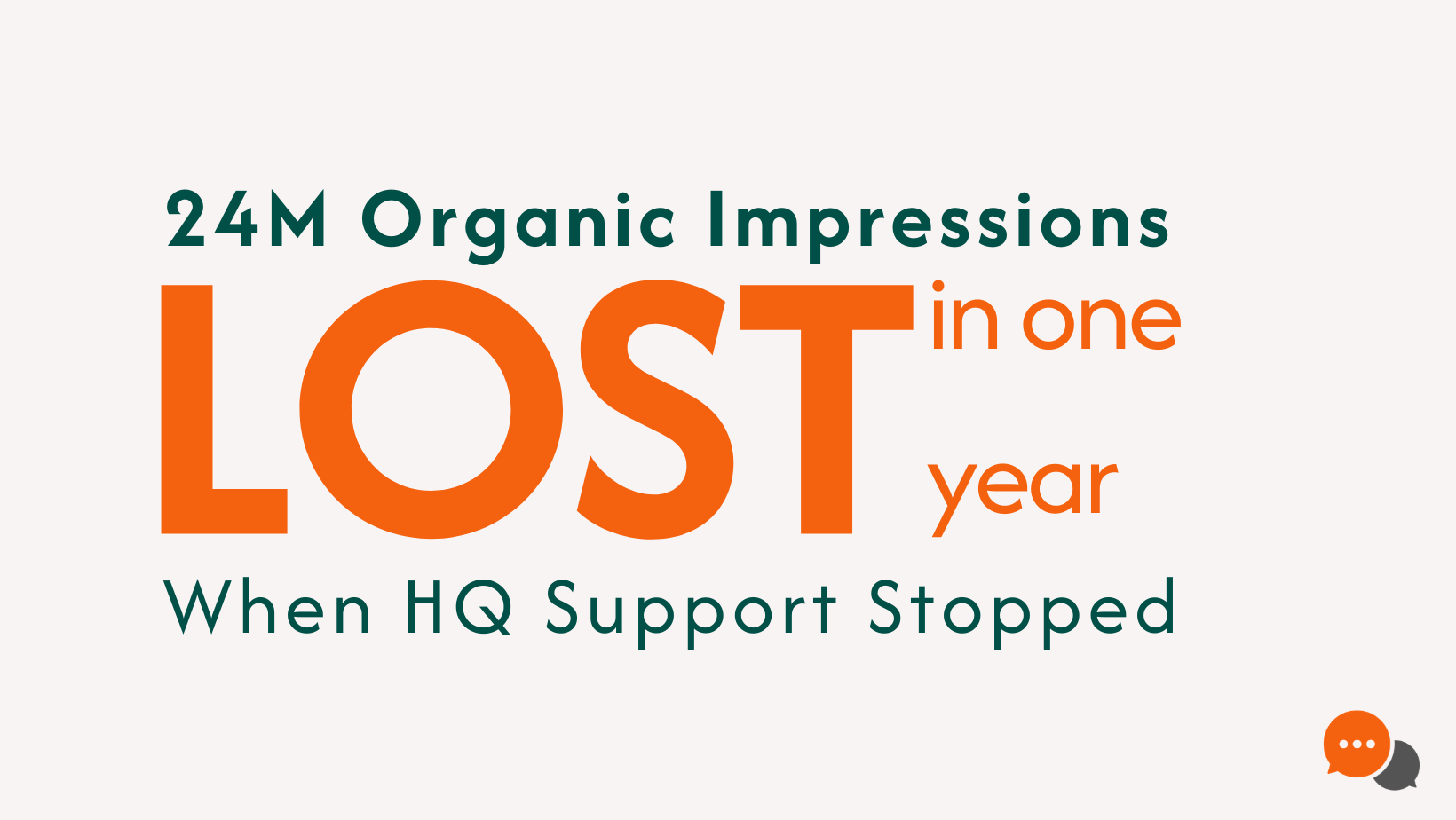
Without support from HQ, that number dropped to around 1.2 million per month.That’s roughly two million impressions disappearing every month.
Over the course of a year, the total loss reached more than 24 million organic impressions.
Organic reach has already declined across social platforms like Meta Platforms, making every impression more valuable than ever. For multi-location brands, those impressions represent thousands of local moments where customers see offers, reminders, new products and reasons to visit their store.
When those moments disappear, brand presence fades locally.
The decline in visibility quickly translated into lower engagement. With head office coordination, the store network averaged 165,000 organic engagements per month.
Without support, that fell to around 59,000 per month - a 64% decline.
Over a year, that represents more than 1.2 million lost interactions.
Local engagement is particularly valuable because it often represents real community behaviour:
These interactions often turn into store visits and sales. Without consistent local content, those conversations simply stop happening.

Some brands assume that paid advertising can compensate for lost organic reach. But replacing 24 million organic impressions with paid media is expensive. According to benchmarks from SuperAds, the average Meta CPM in the UK sits at around £19.6 per 1,000 impressions.
At that rate, buying back those impressions would cost roughly £158,000 per year.
Even then, paid ads behave differently from organic posts. Organic posts feel local, authentic and community-driven. Paid ads feel like advertising. For location-based marketing software strategies, organic local presence is still one of the most effective ways to build community awareness.
When head office steps away from local social media support, the operational burden doesn’t disappear. It shifts to store teams. Maintaining even the reduced posting level across the network would require more than 400 hours of labour every month.
At minimum wage, that equates to roughly £58,000 per year in staff time.
For store managers juggling staffing, stock management, and customer service, running a part-time marketing operation simply isn’t realistic. This is why many modern brands are investing in franchise digital marketing solutions that allow head office to support local execution without increasing manual work.
The biggest takeaway from this example isn’t that brands need to post more content. It’s that local marketing requires coordination and infrastructure.
A single national social page acts like one billboard. But a network of 280 local pages acts like 280 community noticeboards, each connecting with nearby customers.
When supported by an enterprise local marketing solution, campaigns can be distributed instantly across every location while maintaining brand control. This approach enables corporate-to-local marketing that is scalable, brand-safe and consistent across every store.
So what happens when HQ stops supporting local social media?
In this example:
For modern retailers, hospitality groups, and franchise networks, local social media isn’t just another marketing channel. It’s distributed digital infrastructure that connects national brands with local communities. Without the right multi-location marketing platform, that infrastructure becomes fragile. But with the right systems in place, brands can achieve national strategy with local execution - at scale. Book a demo and see how SocioLocal’s powerful, easy-to-use platform helps multi-location brands scale local marketing, strengthen community connection, and drive real results.

